How to Prep Walls for Painting
Step-by-step guide to prepping walls for painting. Cleaning, sanding, patching, and priming techniques for a professional finish.
Paint sticks to clean, smooth, dry walls. That's the whole secret. A $70 gallon of premium paint applied to a dirty, crumbling wall peels off within a year. A $35 gallon on a properly prepped wall lasts a decade. Prep work is not the exciting part of painting, but it is the part that determines whether your work holds up. Skip it and you'll be back in the same room with the same roller, muttering the same curses, sooner than you think.
Inspect Your Walls First
Walk the room with a bright flashlight held flat against the wall at a low angle. Light raking across the surface makes every bump, crack, nail pop, and crater painfully obvious. Circle problem spots with a pencil — don't trust your memory. Here's what you're hunting for:
- Nail holes and screw holes: The easiest fix and the most commonly skipped. Paint magnifies holes, it doesn't fill them.
- Hairline cracks: Common at corners, above door frames, and anywhere the house has settled. If you can feel it with your fingernail, it'll show through paint.
- Water stains: Yellow or brown rings — usually from old roof leaks or plumbing. You absolutely cannot paint over these without a stain-blocking primer. The stain bleeds through latex paint like a highlighter through thin paper.
- Peeling or bubbling paint: Indicates moisture behind the wall or poor adhesion from the previous paint job. Scrape off anything loose before you proceed.
- Dents and gouges: From furniture bumps, doorknob impacts, and everyday life. They cast shadows under raking light that are impossible to ignore after painting.
- Glossy surfaces: High-gloss walls need sanding or a bonding primer. Paint physically cannot grip a slick, shiny surface.
Clean the Walls
Grease, dust, cooking oil, skin oils, and everyday grime create a film barrier between old paint and new paint. Your expensive new paint bonds to the film — not the wall — and delamination is just a matter of time. Kitchens and bathrooms are the worst offenders, but every wall in a lived-in house has some level of contamination.
TSP for heavy-duty cleaning
Trisodium phosphate (TSP) has been the standard wall cleaner for decades. Mix 1/4 cup of TSP powder per gallon of warm water. Wear rubber gloves — TSP dries out skin aggressively. Scrub in sections with a heavy-duty sponge, working top to bottom. Follow each section with a clean water rinse using a separate sponge and bucket. Let walls dry completely — at least 2-3 hours before any sanding or priming. TSP leaves a slightly etched surface that paint grabs extremely well.
Degreasers for kitchens
Kitchen walls collect aerosolized grease from years of cooking. Water-based cleaners don't cut through it. Krud Kutter is the go-to degreaser — spray it on, let it dwell for 3-5 minutes, scrub with a sponge or microfiber cloth, rinse thoroughly. A 50/50 vinegar-water solution works in a pinch but requires more elbow grease. The test: run your clean hand across the dried wall. If it feels slick or greasy at all, clean it again. Paint will fail on any remaining grease film.
Mold and mildew treatment
Bathroom walls with black or green spots need chemical treatment before painting. Mix 1 part household bleach to 3 parts water. Scrub affected areas with the solution, let it sit for 15 minutes, rinse thoroughly with clean water, and dry completely. Paint over live mold and it grows right through the new paint within months. For persistent moisture-prone bathrooms, follow up with a purpose-made mold-killing primer like Zinsser Mold Killing Primer — $25 a quart and absolutely worth it.
Patch and Repair
Every hole, crack, and dent must be filled flat before paint touches the surface. Paint highlights texture differences — a smooth wall with glossy patches where spackle was applied looks worse than the unpainted hole did.
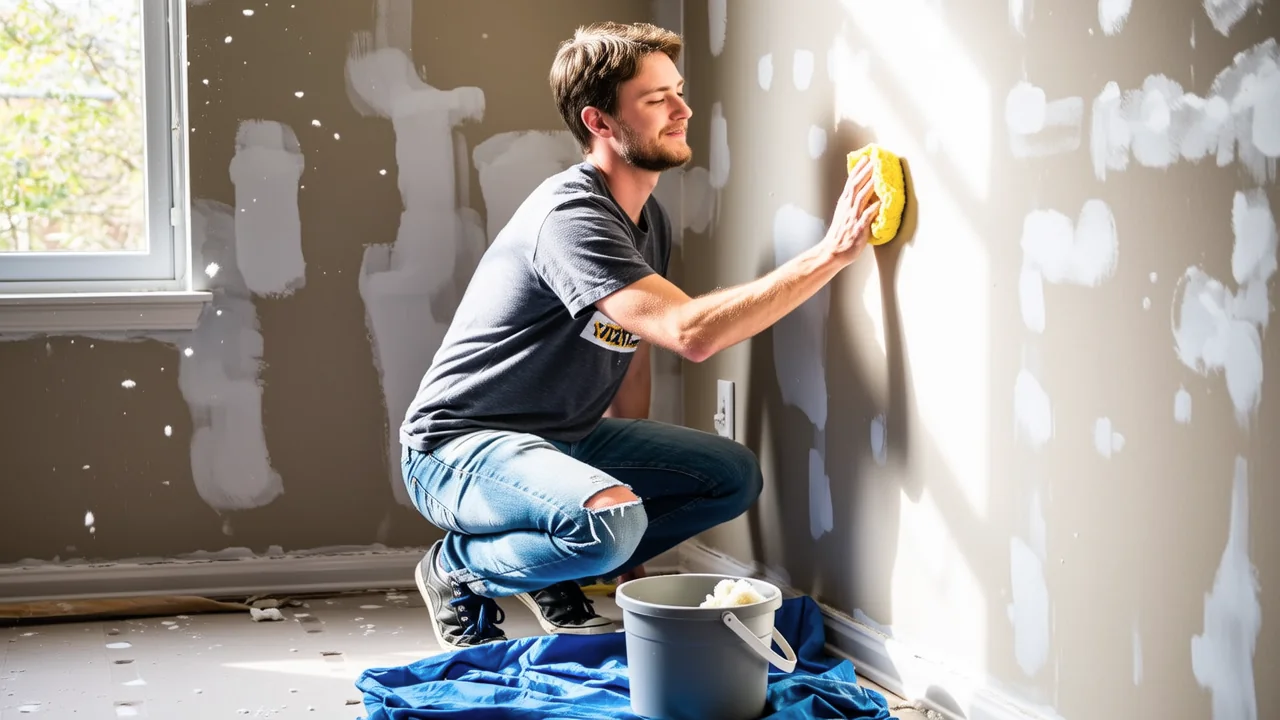
- Small nail holes: DAP DryDex spackle is the standard. Goes on pink, dries white so you know when it's ready to sand. Press into the hole with a 3-inch putty knife, scrape the excess flat with the surface, let dry, sand smooth with 220 grit. Takes 30 seconds per hole.
- Larger holes up to 2 inches: Self-adhesive mesh patch over the hole, then spread lightweight joint compound with a 6-inch drywall knife. Feather the edges out 6 inches beyond the hole so it blends with the wall. First coat shrinks as it dries — apply a thin second coat, let dry, sand flush.
- Cracks: Open up the crack slightly with a utility knife in a V-notch. This gives the filler something to bite into. Fill with flexible painter's caulk (for moving cracks) or spackle (for stable ones). Sand smooth after drying.
- Dents and impact marks: Fill with spackle, scrape flush with a wide knife, sand. The goal is to leave as little spackle on the surface as possible — less sanding, better result.
- Textured walls: After patching a smooth spot on a textured wall, you need to recreate the texture. Homax spray texture cans in orange peel or knockdown patterns are available at any hardware store. Practice on cardboard before spraying your wall. Match the existing texture or the flat patches will be glaringly obvious.
- Nail pops: Drive the popped nail back in with a hammer and set it below the surface with a nail set. Drive a drywall screw 1 inch above or below to secure the drywall. Spackle over both. Skipping the screw means the nail will pop again within months.
Sand Everything
Sanding serves two separate purposes. First, it flattens your patches flush with the wall surface so they don't cast shadows or read as different textures. Second, it scuffs the existing paint — creating 'tooth' — so the new paint has something mechanical to grip. Glossy surfaces especially need this physical abrasion.
- 120 grit: For knocking down spackle patches and rough areas. Fast material removal. Use first on patches and any rough spots on the wall.
- 220 grit: For the final pass over everything. This is what gives you a genuinely smooth, paint-ready surface. Light pressure — you're polishing, not grinding.
- Pole sander: A sanding head on an extension pole saves your shoulders on walls and ceilings. $15 at any hardware store. A sanding block or sponge works for trim and tight spots.
- Between coats: A light pass with 220 grit after the first coat dries knocks down any raised grain, dust nibs, or roller texture. Takes 10 minutes. Makes the second coat lay down noticeably smoother.
- Wear a dust mask (N95 minimum). Drywall dust, old paint dust, and spackle dust are not things you want in your respiratory system. Open a window and run a fan if possible.
Prime or Not?
Primer isn't always mandatory, but guessing wrong means doing the job twice. Here's when it's non-negotiable:
- New drywall: Bare drywall absorbs paint at wildly different rates — the paper face drinks paint differently than the joint compound seams. Result: flashing, where every seam is visible through the paint. PVA drywall primer ($15-20/gal) seals it all to a uniform porosity. The cheapest insurance in painting.
- Dark to light color change: Navy to white without primer means 3-4 full coats of $60 paint instead of 1 coat of $20 primer + 2 coats of paint. The math is simple — primer is cheaper per gallon. Use a gray-tinted primer for the most dramatic color changes.
- Stains: Water stains, smoke residue, crayon, and marker bleed through latex paint no matter how many coats. Zinsser B-I-N (shellac-based, $35/qt) blocks anything. Smells terrible, dries in 15 minutes, works 100% of the time.
- Glossy surfaces: If you're painting over semi-gloss without extensive sanding, a bonding primer (like Zinsser 1-2-3 or Kilz Adhesion) chemically bonds to the slick surface and gives the new paint a mechanical grip.
- Skippable: Same color over previously painted walls in good condition. Light-to-light color changes on clean, dull surfaces. Premium paint-and-primer combos on well-prepped walls that don't need stain blocking.
Tape and Protect
Taping is annoying but the alternative is paint on your trim, ceiling, outlets, and floor. An extra 45 minutes of masking saves 2+ hours of cleanup and touch-up. Here's the right way to do it:
- Use FrogTape (green) for delicate surfaces and fresh paint. The PaintBlock technology activates with moisture to create a micro-barrier. Worth the $7 per roll. ScotchBlue (blue) is fine for general use on cured paint.
- Press the tape edge down firmly with a putty knife or your fingernail along the entire length. The edge is where paint bleeds through if you're casual about adhesion. Run your finger over it — if the edge lifts, press harder.
- Pull tape when paint is slightly wet, not fully dry. Dry latex paint can pull off in sheets with the tape, leaving a ragged edge. If paint has dried, score the tape edge with a utility knife before pulling.
- Canvas drop cloths for floors, not plastic. Canvas ($15 for 9×12) absorbs drips and stays put underfoot. Plastic sheeting is slippery, doesn't absorb anything, and the puddle of paint on top becomes a tracking hazard.
- Plastic sheeting over furniture and fixtures. Roller splatter and overspray travel 3-5 feet from where you're painting. Cover everything you don't want textured with paint specks.
- Remove outlet covers and switch plates. Do not try to tape around them. It takes 30 seconds with a screwdriver per plate. Taped-around outlets always look sloppy because you can't get a clean edge. Put the screws in a sandwich bag taped to the outlet so they don't disappear.
Final Dust Wipe
After sanding, your walls are coated in micro-fine dust that's invisible in normal light but catastrophic under paint. Paint bonds to the dust instead of the wall, creating a gritty texture and poor adhesion that causes premature failure.
- Damp microfiber cloth: Just water, no cleaning products. Wring it out until it's barely damp — excess water raises drywall paper grain. Start at the top of the wall and work down. Rinse the cloth whenever it looks dusty.
- Tack cloths: Sticky cheesecloth ($3 each at any paint store) grabs the finest dust particles that a regular cloth misses. Lightly wipe — don't scrub or it'll leave sticky residue.
- Let the wall dry 10-15 minutes after wiping before you open a paint can. Painting on a damp wall causes adhesion issues and slows dry time.
- Don't forget baseboards. Dust settles on horizontal surfaces. Wipe baseboards clean before taping them or the tape won't stick properly.
- This step is the #1 thing first-timers skip. It takes 15 minutes. The dust you don't wipe will end up as grit in your paint, and you'll feel it every time you touch the wall.
Curious what your project costs? Use the paint cost calculator for paint, labor, and DIY vs. pro estimates based on your exact rooms.