Paint Sprayer vs Roller vs Brush: Complete Comparison
Paint sprayer vs roller vs brush comparison. Learn which tool is best for walls, trim, furniture, and exterior projects.
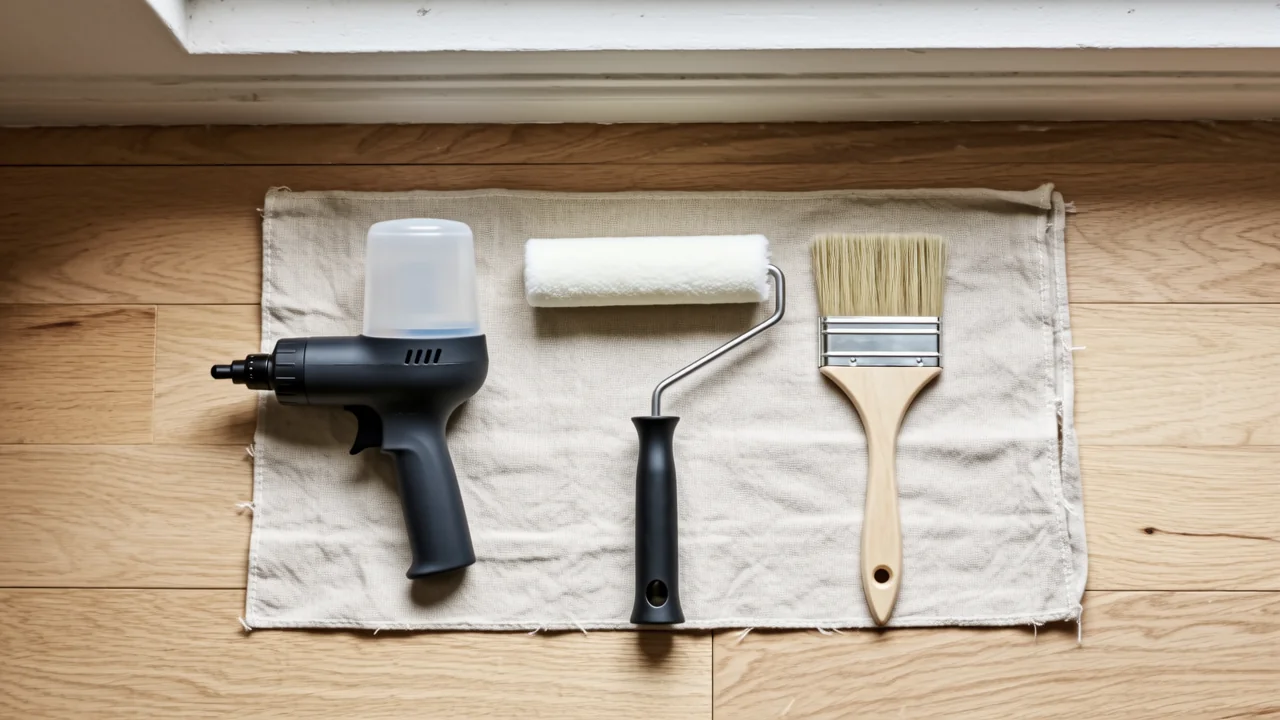
Sprayers are the fastest. Rollers are the most forgiving. Brushes are the most precise. No single tool handles every part of a paint job correctly — real paint work uses at least two and often all three. The skill isn't picking the best tool. It's knowing which tool for which surface, which stage, and which room.
Paint Sprayer: Speed with a Learning Curve
An airless sprayer atomizes paint into a fine mist and blasts it onto the surface at high pressure. Properly dialed in, it lays down a glass-smooth finish that no roller can match. Set up wrong, you get runs, drips, massive overspray, and a fine paint dust that coats everything in the room you didn't mask. There's no middle ground between 'perfect' and 'disaster' with a sprayer — the tool rewards careful setup and punishes shortcuts severely.
Best for
- Exterior siding: A 2,000 sq ft exterior that takes 4 days by hand can be sprayed in one day. Lap siding, board and batten, T1-11 — sprayers handle large, repetitive exterior surfaces faster than any alternative.
- New construction and vacant rooms: Empty rooms with no furniture, no trim installed, no finished floors. The masking is minimal because there's nothing to protect. Spray prime and back-roll with a roller to work the paint into the drywall.
- Cabinet doors and furniture: The factory-smooth finish on professionally painted cabinets comes from an HVLP (high-volume low-pressure) sprayer. These units atomize fine-finish paints and lacquers to a level rollers can't approach. You also need a dust-free spray booth — garage with plastic sheeting works.
- Textured surfaces: Stucco, brick, popcorn ceilings — rollers and brushes fight these surfaces. Sprayers cover every peak and valley evenly without the physical effort of pushing paint into crevices.
- Fences, decks, and outdoor structures: Large area, irregular surfaces, many spindles or pickets. A sprayer reduces a weekend deck-staining project to an afternoon.
Not ideal for
- Small single rooms: The time you gain spraying a 12x12 bedroom is lost — and then some — to masking. You need to cover every surface not being painted: floors, windows, trim, ceiling, outlets, switches, light fixtures. Masking a fully furnished room for spraying takes longer than just rolling the walls.
- Detail work: Sprayers are blunt instruments. You can't cut a clean line at a ceiling or along trim with one. You'll always need a brush to cut in edges, even on fully sprayed rooms.
- Occupied homes: Overspray — the fine paint mist that doesn't land on the wall — travels 10-15 feet and settles like dust on every horizontal surface. In a furnished home, you're either moving everything out or wrapping it in plastic like a crime scene.
- First-time DIYers: Sprayers have a technique: the right pressure setting, the right tip size, the right distance and speed, and the right overlap pattern. Expect to practice on cardboard for an hour before you touch a real wall. Getting it wrong produces runs that need to be sanded flat and repainted.
Cost
Entry-level airless sprayers (Graco Magnum X5): $250-300. Mid-range (Graco Magnum X7): $400. HVLP sprayers for fine finish work (Fuji Semi-PRO 2): $400-900. Rental from Home Depot or Sunbelt: $40-80 per day. For a one-time exterior job, rental makes sense. If you'll paint multiple rooms or plan cabinet refinishing, buying pays for itself in labor savings.
Paint Roller: The DIY Workhorse
The roller is the correct tool for 80% of interior walls. It's fast enough for large surfaces, forgiving enough for complete beginners, and cheap enough that owning one is a non-decision. The only meaningful choices are nap thickness and technique.
Best for
- Interior walls and ceilings: Flat, large surfaces where you need uniform coverage without the masking marathon required by a sprayer. A 9-inch roller covers a 12-foot wall in about 3 passes.
- Single rooms: A 12x12 bedroom takes 20-30 minutes per coat with a roller. By comparison, masking alone for a sprayer on the same room runs 45-60 minutes.
- Beginner painters: Rolling has a 5-minute learning curve. Maintain even pressure, don't oversaturate, and overlap passes by 50%. Even first-timer results are acceptable to good.
- Textured drywall: A 1/2-inch nap roller reaches into orange peel and knockdown texture valleys. Brushes skip over texture high points and leave the valleys bare.
- Budget-conscious projects: A full roller kit costs $25 and lasts for multiple rooms. Replacement covers are $5 each.
Not ideal for
- Detailed surfaces: Rollers can't do trim, corners, narrow door frames, or edges. You'll always need a brush to cut in first.
- Furniture-grade finishes: Roller stipple — the slight orange-peel texture — is unavoidable. For mirror-smooth cabinet doors and furniture, you need a sprayer.
- Exterior rough surfaces: Rolling stucco or brick is physically punishing and wastes enormous amounts of paint into thick nap covers. Sprayers are the only sane choice for these surfaces.
- Ceilings if you have back problems: Rolling overhead for an extended period is one of the most physically demanding painting activities. An extension pole helps enormously, but a sprayer eliminates the overhead strain entirely.
Paint Brush: Precision Over Speed
Brushes are objectively slow. They're also irreplaceable. No sprayer or roller can cut a straight line at a ceiling, paint the narrow face of door casing, or fill nail-hole touch-ups without making a mess bigger than the job. A quality brush in skilled hands is the difference between a room that looks painted and a room that looks finished.
Best for
- Cutting in edges: Where wall meets ceiling, wall meets trim, or two wall colors meet. A 2.5-inch angled sash brush gives you the control to paint a straight line without tape — a skill that repays the practice time many times over.
- Trim, baseboards, door frames: Narrow surfaces that a 9-inch roller is absurdly oversized for. A brush covers them in one pass with no masking needed.
- Small touch-ups: Quarter-sized nail holes, scuffs, and dings. You don't need a roller and tray for a 2-inch repair. Load a small brush, dab it on, and feather the edges.
- Detail and decorative work: Window mullions, wainscoting grooves, crown molding profiles, chair rails. No other tool gives you the fine control to paint only what you intend to paint.
- Oil-based paints and varnishes: Natural bristle brushes (China bristle, ox hair) lay out oil-based paints with minimal brush marks. Nylon/polyester brushes are for latex. Using the wrong bristle type with the wrong paint creates a streaky, uneven mess.
| Feature | Sprayer | Roller | Brush |
|---|---|---|---|
| Speed | Extremely fast — whole room in minutes | Fast — 20-30 min per coat per room | Slow — 1-2 hours to cut in a room |
| Cost to start | $250-400 buy, $40-80/day rent | $25-40 complete kit | $12-20 per quality brush |
| Learning curve | Steep — pressure, tip, speed, masking | Minimal — 5-10 minutes | Moderate — cutting clean lines takes practice |
| Surface finish | Glass-smooth when dialed in | Slight stipple texture | Brush marks visible if technique is bad |
| Best surface | Large, empty spaces | Interior walls, ceilings | Edges, trim, detail, touch-ups |
| Cleanup time | 30-60 min to flush system | 5 min with disposable liners | 2-3 min per brush |
| Paint waste | 20-30% lost to overspray | 5-10% left in tray/roller | Minimal — nearly all used |
| Masking needed | Extensive — everything covered | Minimal — trim and floor edges | Minimal — mostly for drips |
When to Use Multiple Tools
No real paint job uses a single tool. The standard interior approach: cut in the top 2-3 inches of wall at the ceiling, around outlets, and along baseboards with a brush. Then roll the field with a 9-inch roller, overlapping the cut-in edge by an inch or two to blend. For cabinet refinishing: remove doors, spray them in the garage with an HVLP, roll or brush the cabinet frames in place. Even pros who spray entire rooms still use a brush and mini roller for the detail work the sprayer can't handle. The brush-and-roller combo handles 90% of interior work. Add a sprayer when the scale or finish demands it.
- Brush for cut-in + roller for field: The universal interior approach. Brush the edges, roll the walls. Done properly, you can't see the transition.
- Sprayer for cabinets + brush for room walls: Remove doors and drawer fronts, spray them for factory finish, roll and brush the room. Reinstall the sprayed doors when everything's dry.
- Roller for walls + brush for trim: Paint walls first (it's easier to cut trim over slightly overlapped wall paint than the reverse), then brush-paint the trim and baseboards.
- 5-gallon bucket with roller grid instead of paint tray: Holds more paint, tips over less often, and reloading is faster than running a roller through a shallow tray. Saves time and frustration on any job bigger than a single room.