Painting Over Dark Walls: How Much Extra Paint You Actually Need
A dark-to-light repaint can take 4 layers of product and double your paint. Here's how many gallons you need, and how a gray primer saves a coat.
Someone posted in r/HomeImprovement this summer that they'd laid down two coats of Kilz 2 primer and two coats of Behr paint-and-primer, and the old blue was still showing through on some walls. Their fifth coat, they figured, wouldn't help either. I read that and nodded, because this is the exact trap a dark-to-light repaint sets: you think you're nearly done, then the old color winks at you through the new white. This guide covers the part the how-to videos skip. Not how to roll paint, but how many extra gallons a dark-to-light change actually costs you, and how to keep that number down.
Why dark walls fight back
Coverage isn't about thickness. It's about how much pigment sits in the film and how opaque that pigment is. Light paints get their hiding power from titanium dioxide. Dark paints get their depth from heavy color pigment and very little titanium dioxide. So when you roll a light color over a dark one, you're asking a thin layer of weakly-hiding paint to block a strongly-colored one underneath. It can't, in a single pass. Every extra coat is the paint slowly building up enough opacity to win.
Grade the jump with LRV, not your gut
Paint stores print a number on the back of every swatch called Light Reflectance Value, or LRV. Zero is a black that swallows light; 100 is a white that bounces almost all of it. Sherwin-Williams puts the LRV on the back of each color chip, and the gap between your old color's LRV and your new one's tells you, roughly, how many coats you're in for. A real example: Tricorn Black sits at LRV 3. Chantilly Lace, a bright white, sits near 90. That's an 87-point jump. Going from a soft greige at LRV 60 to that same white is only a 30-point gap, and it behaves nothing like the black.
| LRV gap (old to new) | What it looks like | Primer | Finish coats |
|---|---|---|---|
| Under 20 | Light gray to white, or white to white | Optional | 2 |
| 20 to 40 | Medium blue or green to white | 1 coat | 2 |
| 40 to 60 | Deep navy or forest green to white | 1 to 2 coats | 2 to 3 |
| Over 60 | Black (LRV ~3) to bright white (LRV ~90) | 1 to 2 coats, gray primer | 3 |
What it costs in real gallons (a 12x12 room)
Enough theory. Take a 12x12 room with 8-foot ceilings, one door, one window. About 348 square feet of wall to paint. At 350 square feet per gallon, that's roughly one gallon per coat. Watch what happens as the color jump grows:
| Color change | Layers | Gallons (rounded up) | Cost at ~$45/gal paint, ~$28 primer |
|---|---|---|---|
| Light gray to white (gap under 20) | 2 coats paint | 2 gallons | About $90 |
| Medium blue to white (20 to 40) | 1 primer + 2 paint | 3 gallons | About $118 |
| Deep navy to white (40 to 60) | 1 primer + 3 paint | 4 gallons | About $163 |
| Black to white, white primer (over 60) | 2 primer + 3 paint | 5 gallons | About $191 |
| Black to white, gray primer (over 60) | 1 primer + 3 paint | 4 gallons | About $163 |
The black-to-white room runs about twice the paint of the light-gray-to-white room. That's the number people miss when they price a 'simple' repaint. For your own room, the paint calculator does the math from your dimensions and the coat count above.
Better paint can buy back a coat
Paint quality moves the count more than most expect. Premium lines like Sherwin-Williams Emerald or Benjamin Moore Aura carry more solids and hiding pigment, and painters report they cover a dark color in one coat over primer where a budget paint needs two. On a 12x12 that's the difference between three gallons and four. Budget paint on a dark-to-light job is a false economy. PPG's own cost analysis, which contractors cite, lands on the same point: buying four gallons of cheap paint to get coverage costs more than two gallons of premium. Spend up on the paint, not the primer.
Why white primer loses to dark walls
Back to that Reddit post. Two coats of Kilz 2, blue still showing. The mistake wasn't the brand. It was the color. Kilz 2 comes in white and gray. Over a dark color, white primer needs two or three coats just to stop the old color from bleeding through. Gray primer is built for this: Kilz's own gray version is made 'under dark, rich colors' to reach full coverage in fewer coats, and painters consistently say gray primer covers a black wall in one coat where white needs two or three. The person with the blue walls almost certainly used white Kilz 2. One can of gray primer would have saved a coat of primer and probably a coat of paint.
This is the most common way people waste paint on a dark-to-light job. They grab the primer in white because it's on the shelf, then pay for it three coats later.
The cheap-base-coat idea
Another r/HomeImprovement regular had the opposite problem. Light walls, wanted a dark green (Sherwin-Williams Oakmoss). They wondered if buying a gallon or two of cheap dark paint as a base, then one coat of real Oakmoss on top, would save money. They updated the post to say everyone talked them out of it. They were right to listen.
Light to dark is the easy direction. You almost never need primer; two coats of the actual finish color cover a light wall fine. A cheap base coat just adds a whole extra layer of labor for a worse result, because the cheap paint has weak hiding and can shift the final color. Want Oakmoss on a light wall? Buy two gallons of Oakmoss and roll two coats. Skipping the throwaway layer saves a step and about $25 of paint that was never going to help.
The one time a base coat makes sense going dark is covering a weird saturated color like red, where a tinted primer underneath stops the red from bleeding. But that's a primer, not a cheap can of leftover paint.
Two problems that look the same
The blue-wall poster also said some walls looked patchy and blamed the roller. That's a different problem from bleed-through, and the fix runs the other way. Bleed-through means the old color shows through a dry coat. Patchiness means the sheen or thickness is uneven across a wall that's actually the right color. Bleed-through needs more coats. Patchiness usually means the paint went on unevenly, dried too fast, or the wall wasn't sealed. More coats won't fix patchy. Consistent technique and full drying time between passes will.
Mixing these up gets expensive. People who see patchiness and assume it's the old color keep rolling, and now they've burned a third gallon on a problem that was never about coverage.
Going the other way: light walls, dark paint
Dark over light is easier, but it has its own trap. Saturated darks are stubborn. They carry so much pigment that the light wall underneath can ghost through the first coat. A tinted primer helps here too. And dark colors show every roller mark, so technique matters more than the coat count. Two coats of a decent dark paint over a light wall is normal. Three means something underneath is fighting you.
The colors that refuse to cover
- Red. High pigment load, and it bleeds. Covering red with anything light often needs a stain-blocking primer, not just a gray one.
- Yellow. Thin, translucent pigment. Over a dark wall it can take four coats to look right.
- Deep blue and forest green. Better than red, but a black-to-deep-blue change is still a big LRV jump and will want primer plus three.
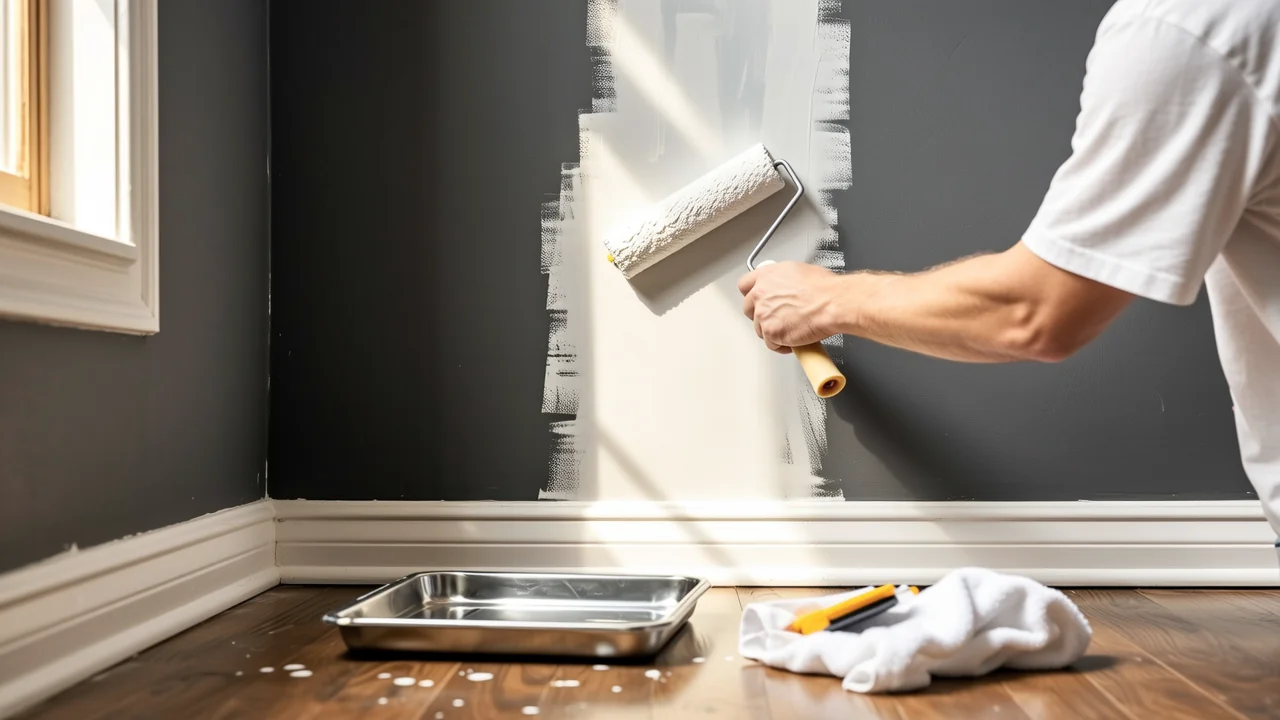
When a third coat is fair, and when you're being upsold
A painter quoted one homeowner a third coat for a dark Sherwin-Williams color (Westhaven) and the homeowner smelled a ripoff. Sometimes it is. But a third finish coat is legitimate on a high-LRV-jump dark-to-light job when the second coat still ghosts in raking light. What isn't legitimate is a third coat on a light-to-light change, or a contractor who won't show you the wall in daylight before charging more. Ask to see it near a window. If the old color is gone, you don't need another coat.
How much to actually buy
Everything above comes down to two inputs: your room's dimensions and the size of the color jump. Punch the length, width, and height into the calculator, set the coats from the table, and it gives you the gallons. For a black-to-white 12x12, plan on four gallons of product and don't be surprised when the store says you need more than you guessed. For a light-gray-to-white same room, two gallons does it. The calculator takes the guessing out, which is the whole point.
How many coats does it take to cover a dark wall?
Do I really need primer, or is paint-and-primer enough?
Why is my wall patchy even after enough coats?
My painter wants a third coat. Normal or upsell?
Can I use cheap dark paint as a base coat to save money?
How much extra paint should I buy for a dark-to-light change?
The bottom line
A dark-to-light repaint is the most paint-hungry job there is, and most of the waste is avoidable. Buy gray primer, not white. Count your coats from the LRV gap, not from a feeling. And check the wall in daylight before you approve another coat, yours or a contractor's. Do those three things and a black-to-white room costs you four gallons instead of six.